Thirteen subject areas aimed at improving foundational learning and equipping pupils with 21st-century skills, values and ethics are to be the focus in a revised curriculum prepared by the National Council for Curriculum and Assessment (NaCCA) aimed at introducing or strengthening basic level education.
The newly revised curriculum for kindergarten and primary education include Ghanaian Language, English Language, Chinese, Arabic, French, Religious and Moral Education, Mathematics, Physical Education and Health, Creative Arts, Citizenship Education, Computing and Science (Agriculture), all for primary education alone.
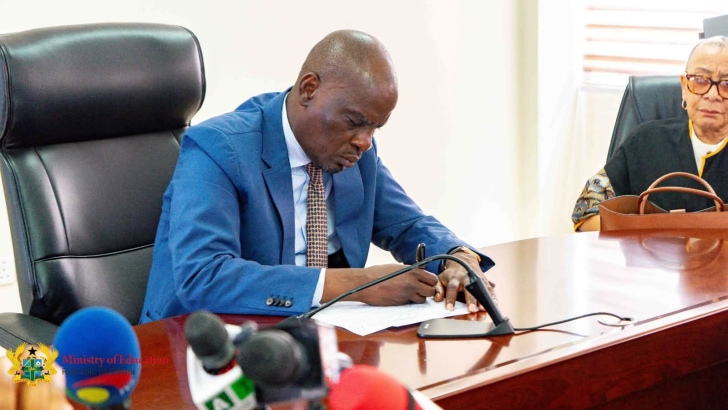
The revised curriculum, covering Kindergarten to Primary Six, was submitted to the Minister of Education, Haruna Iddrisu, in Accra on Wednesday (July 22, 2926) by the Director-General of NaCCA, Professor Samuel Ofori Bekoe, who led the committee on the curriculum revision.
The minister consequently tasked the Ghana Education Service (GES) to review the revised curriculum within one week and bring it to “full implementation readiness and strict quality standards” to ensure smooth classroom execution.
Graphic Online’s Pacome Emmanuel Damalie reports that presenting the document, the Director-General of NaCCA said the revised curriculum would address learning gaps, reduce subject overload, and align with new national priorities as part of the fulfilment of the government’s manifesto pledge.
Prof. Ofori Bekoe said an evaluation of the existing curriculum identified gaps in Mathematics, English, and the teaching of Ghanaian culture and values.
To address this, he said, NaCCA convened 160 experts and a technical working group to map and redesign the curriculum.
He outlined four major structural changes.
Citizenship Education has been reintroduced to consolidate civic competencies, values, history and attitudes into one subject instead of spreading them across many.
Computing and Mathematics now include computational and quantitative thinking to introduce learners to coding, automation and artificial intelligence (AI) concepts.
Agriculture has been integrated into Science as a strand, rather than as a standalone subject, to avoid adding to the number of subjects.
Meanwhile, assessment as a concept has been made task-based and formative, with three-tier standards — basic, attained, and deeper — to guide teachers on remediation.
On languages, Prof. Ofori Bekoe said foreign language teaching would now start from Primary One instead of Primary 4 to improve proficiency.
He added that the revised curriculum had also standardised “Arabic” from Primary One to Six, and had introduced “Chinese” as an optional foreign language.
He said the Confucius Centre had offered to pilot Chinese in 10 schools with three teachers.
Prof. Ofori Bekoe affirmed that ethics and values had been deliberately embedded for teachers to teach and assess learners.
Achievement, commendation
The Education Minister described the curriculum reform as his “single most important achievement”, stressing that his legacy should be measured by “the moulding of character and the production of ethically responsible citizens with problem-solving minds”.
He affirmed that government had approved Ghanaian language as the medium of instruction from Kindergarten to Basic
Three, with English taught as a subject to strengthen early literacy.
Mr Iddrisu said grounding children in their native language would improve cognitive development and reading comprehension, which in turn would accelerate second language learning.
“Learners at this level will be taught to read in a Ghanaian language. English Language will be taught as a subject with an explicit emphasis on play-based oral activity,” he stated.
He welcomed the inclusion of citizenship education, cultural values, and ethics in the new curriculum, and called for greater focus on assessment for learning rather than rote memorisation.
Mr Iddrisu also directed GES to prioritise the recruitment of Ghanaian language teachers in the next recruitment cycle, following requests from traditional leaders, including in the Greater Accra Region.
He further commended NaCCA for introducing early exposure to modern foreign languages such as Chinese, French, Arabic, Spanish, Italian and German to prepare learners for a global economy.
Credit:graphic.com.gh
About Author